
Why the design industry needs a new standard for client collaboration
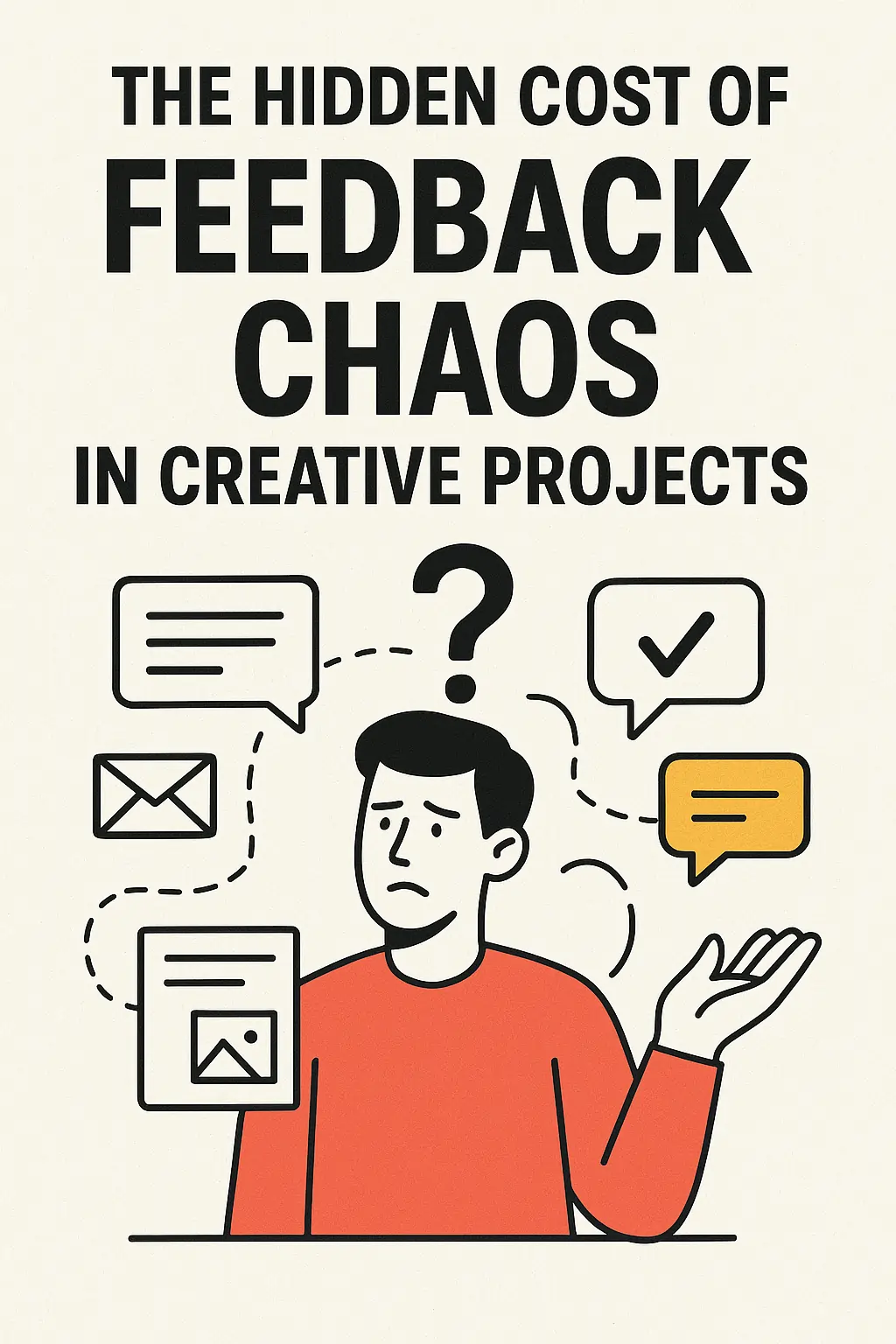
Creative work has never been more in demand, yet the way designers and clients collaborate is still stuck in the past. Email threads, scattered attachments, WhatsApp messages at midnight, “final‑final‑v3.pdf”. It’s a workflow built on friction and friction has a cost.
Not just in time, not just in frustration, but in lost revenue, damaged trust, and creative burnout.
As a designer that wants to improve collaboration, I’ve interviewed creatives about their process. The pattern is clear: the biggest threat to a designer’s productivity isn’t skill, competition, or AI, it’s feedback chaos.
Let’s break down what that really means.
1. Fragmented communication destroys momentum
Design is iterative. It thrives on clarity, context, and continuity. But when feedback arrives across five different channels, designers spend more time finding comments than acting on them.
- “Can you use the logo from the email I sent last week?”
- “Ignore the feedback I gave on WhatsApp, use the version from the PDF I emailed.”
- “I think I left a note on the Figma file, somewhere.”
Every interruption resets focus. Every reset costs minutes. Those minutes compound into hours. And those hours quietly erode profitability.
2. Clients don’t realise how much chaos they create
Most clients aren’t trying to be difficult. They simply don’t see the workflow from the designer’s side.
To them, sending feedback via email, WhatsApp, and a forwarded message from their colleague feels normal. They don’t see the versioning nightmare it creates. They don’t see the duplicated work. They don’t see the cost.
Designers end up absorbing that cost, financially and emotionally.
3. “Just one more change” becomes a business model killer
Scope creep rarely arrives as a big request. It arrives as a series of tiny, disorganised messages:
- “Quick tweak”
- “Small update”
- “Can we try one more version?”
When feedback is scattered, it becomes impossible to track what’s new, what’s approved, and what’s out of scope. Designers end up doing unpaid work simply because the process has no structure.
Chaos becomes the default. And chaos is expensive.
4. Creative energy is finite — and chaos drains it
Designers aren’t machines. They’re problem‑solvers, storytellers, and thinkers. But when their day is dominated by admin, hunting for files, and reconciling conflicting feedback, their creative energy evaporates.
Burnout isn’t caused by creativity. It’s caused by everything that gets in the way of creativity.
5. The industry needs a new standard — not another generic tool
Designers have tried to fix this with:
- Google Drive
- Notion
- Trello
- Figma comments
- PDFs with annotations
But these tools weren’t built for the designer to client relationship. They’re general‑purpose platforms trying to solve a specialised problem.
What the industry needs is a single source of truth, a shared space where:
- feedback is structured
- files are versioned
- approvals are clear
- clients understand the process
- designers stay in control
Not more tools. Better tools. Purpose‑built tools.
The future of creative collaboration is clarity
The next decade of design won’t be defined by AI replacing creativity. It will be defined by systems that remove friction, protect creative time, and elevate the designer to client relationship.
Studios that adopt structured workflows will scale faster. Freelancers who control their process will earn more. Clients who understand the system will get better work.
Chaos has been the norm for too long. It’s time for clarity to become the competitive advantage.